
Beryllium double bond predicted

Proposed Be–Be bond would be first double bond between s block elements using only π electrons By Jamie Purcell Source: © Royal Society of Chemistry Charge decomposition analysis showed that the degenerate Homo−1 in Be2Li4 containing four electrons has lower energy than the original fragments’ orbitals; thus, double-π bonds inside sustain and steady the whole skeleton […]
Hepatitis C drug lead designed to target virus RNA

[:pb] By James Urquhart The longstanding goal of designing RNA-targeting drugs has been given a boost thanks to a technique that identifies drug-like small molecules which selectively bind to disease-causing RNA. The US team demonstrated the approach by designing an antiviral drug lead for hepatitis C based on its RNA sequence and suggest the technique […]
Superacid helps scientists solve protonated white phosphorus structure
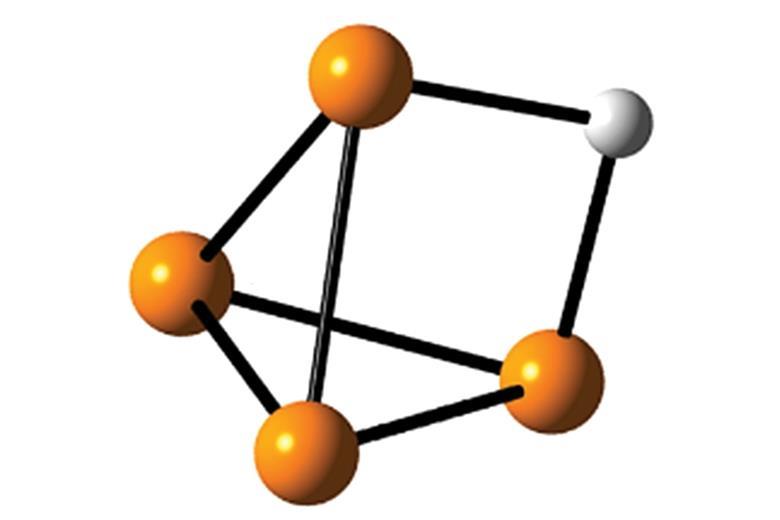
[:pb]By Eve Rooks Findings set to fuel phosphorus activation research Source: © Royal Society of Chemistry The weakly bonded hydrogen of [P4H]+ sits on the edge of the P4-tetrahedron A team from Germany has made protonated white phosphorus in solution using a Brønsted superacid, and experimentally confirmed that the weakly bonded hydrogen of [P4H]+ sits […]
Super-reactive molecule could solve space sugar mystery

[:pb] By Katrina Krämer How did carbohydrates form in space and on early Earth? The clue might be in the carbene A highly reactive molecule might solve the puzzle of how sugars formed in interstellar space and on prebiotic Earth. Even under space-like conditions – without water and at ultralow temperatures – the carbene compound […]
Blood markers predict which firefighters will go on to develop lung disease linked to WTC attacks

By Rebecca Trager Two dozen metabolites in blood samples from firefighters who were exposed to the dust and smoke from the World Trade Center (WTC) towers, during the 11 September 2001 terrorist attacks in New York City, can accurately predict which will develop lung disease. The research, carried out by a team at New York […]
The alphabet soup of life
[:pb]By Rachel Brazil Why did nature stop at 20 amino acids? Rachel Brazil tries to answer the question – and see what it means for how life began and evolved For many researchers, studying the chemical origins of life is a side project – it’s what they do in between their grant-funded work on the […]


