
Titanium complex converts methane to alkenes at room temperature

New work illustrates the ‘crucial steps’ required for a process to make useful chemical feedstocks from methane Source: © Royal Society of Chemistry Room temperature olefination of methane with titanium–carbon multiple bonds Researchers in the US and South Korea have developed way to convert methane into alkenes at room temperature. Such a process could […]
A reluctant chemist

In August 1914 a million Frenchmen were called to arms. Among them was a 43 year old professor, restored to the rank he had held many years earlier during his compulsory military service. Corporal Grignard spent the early months of the first world war on routine guard duties, until the army realised that a world-class […]
Bacteria churn out a million potential protein drugs

By Katrina Krämer With the help of a cyanobacterium enzyme that cyclises short protein strands, researchers have transformed Escherichia coli into tiny factories that produced a million different macrocyclic proteins – compounds that might be able to tackle diseases such as HIV. Most small molecule drugs inhibit proteins by binding to their active sites in […]
Longest carbon–carbon bond yet pushes chemistry to its limits
The longest ever carbon–carbon bond has been created by researchers in Japan.1 At more than 1.8Å, this bond is longer than the maximum possible bond length calculated for certain alkanes and longer than the shortest non-bonding distance2 between two carbon atoms. ‘Looking for structures with particularly long or short bonds is telling us much about […]
Cyclopropanation catalysis opens door to greener chemistry

Source: © American Chemical Society Haem proteins were engineered to enable them to carry out a cyclopropanation reaction never carried out by an enzyme before. Unactivated alkenes have been transformed into four stereoisomers of cyclopropane by a group of enzymes – the first example of a biocatalytic reaction performed by haem proteins that does not […]
Simple synthesis makes curious chiral clamshell molecule
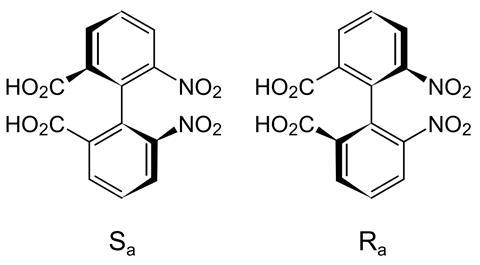
Compounds with two chiral axes hold promise for catalysis and even molecular machines A class of molecules that look like open scallop shells has been made by French researchers.1 This is the first time these curious compounds, whose chirality comes from hindered rotation around two bonds, have been synthesised in a single straightforward reaction. Most […]
Malacidins have a novel mode of action and can kill MRSA
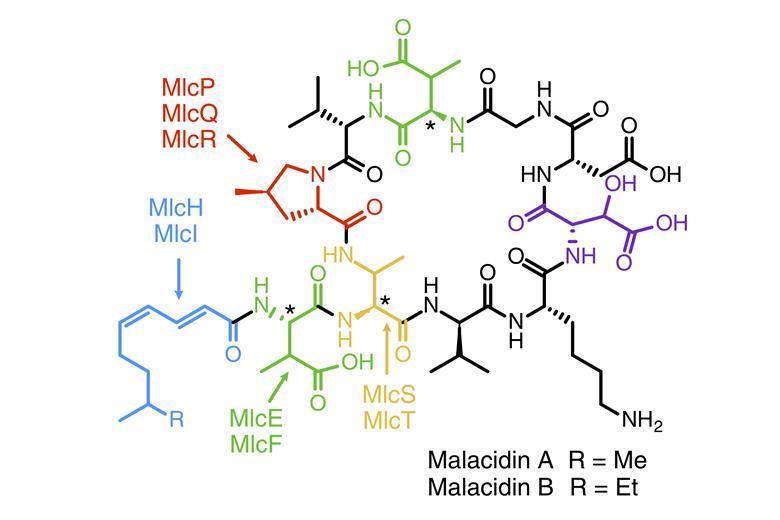
Malacidins have a novel mode of action and can kill MRSA A new class of antibiotics – named malacidins – has been discovered by researchers genetically screening microbes from crowdsourced soil samples. The discovery came from a citizen science project – Drugs from dirt – started by Sean Brady of the Rockefeller University, US. The […]
Photoredox sugar synthesis plausible on early Earth

Study using prebiotically realistic wavelengths adds weight to origin-of-life theory Scientists in the US have carried out experiments confirming that ultraviolet light could have driven the synthesis of simple prebiotically important sugars under conditions found on early Earth.1 Source: © Royal Society of Chemistry UV light photooxidises cyanocuprates, producing aqueous electrons, which are key for […]
Call to erase aqueous sulfide ion from chemistry

Spectroscopic developments question the existence of aqueous sulfide ions Source: Shutterstock For decades, scientists have used sulfide ions (S2-) in their calculations with little debate. Now, however, scientists in Australia argue that S2- should be stricken from the literature, potentially invalidating some older work.1 A project investigating the use of sulfide solutions to reduce mercury […]
Antibiotic analogue puts researchers on path to ending herbicide drought

Research flags DNA gyrase as a new target for pesticides Scientists in Australia and the UK have found the first new herbicidal mode of action in over 20 years by modifying the antibiotic ciprofloxacin. They successfully synthesised a ciprofloxacin analogue that selectively targets an enzyme required for plant growth, yet has decreased antibacterial activity. The […]
Can you hear the chemistry?

A well-trained ear can determine the concentration and pH of a strong acid just by listening, new research suggests. But fear not, you don’t have to be a piano tuner to exploit these findings. A new method, developed by Dara Fitzpatrick from University College Cork, Ireland, and his colleagues, uses broadband acoustic resonance dissolution spectroscopy, […]
Ultra-efficient removal of carbon monoxide using gold nanoparticles on a molecular support
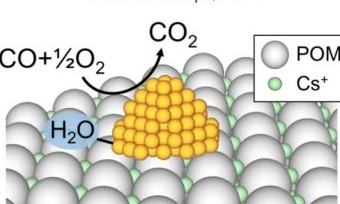
New method and mechanism for state-of-the-art gas purification Summary: Researchers have developed a way to mount gold nanoparticles on a molecular support known as a polyoxometalate (POM). They successfully applied this to realize nearly 100% conversion of carbon monoxide (CO) over a wide temperature range, demonstrating stable performance over long periods of time. They showed […]


